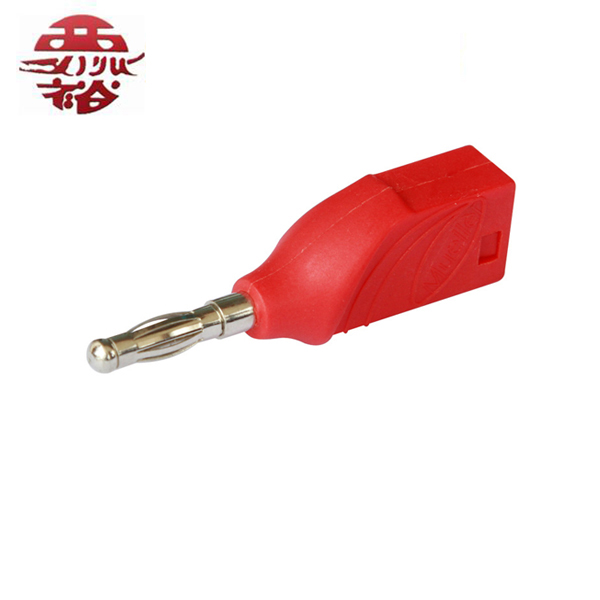
4mm cable for 4 banana plugs Core strengths description
The plug is typically a fourleafed spring tip that fits snugly into the jack. The plugs are frequently used to terminate patch cords forelectronic test equipment. They are also often used as the plugs on the cables connecting the amplifier to the loudspeakers in hi-fi sound systems.
4mm cable for 4 banana plugsintroduction
The pin's diameter is nominally 4 mm (0.16 in). The pin has one or more lengthwise springs that bulge outwards slightly, giving the appearance of a banana. Taking the springs into account, the actual diameter of a banana plug is typically a bit larger than 4 mm when not plugged in. When inserted into a matching 4 mm socket the springs press against the sides of the socket, improving the electrical contact and preventing the pin from falling out. The curved profile of these springs is probably the origin of the name "banana plug". The other end of the plug has a lug connector to which a length of flexible insulated equipment wire can be attached, which is either screwed, soldered, or crimped into place. An insulating plastic cover is usually fitted over this rear end of the connector.
The rear end of a 4 mm plug often has a 4 mm hole drilled in it, either transversely or axially, or both, to accept the pin of another 4 mm plug. This type is called a "stackable" 4 mm plug.
Banana Plugs Explosion Diagram
The length range of banana plugs: 27mm59mm
The general materials of banana plugs: Body:Brass Spring: Steel, Beryllium copper Surface: Nickel plated, Gold plated Insulator: PVC, ABS, PA, PE
Banana PlugsApplicable
A number of widely used plugs are based on combining 2 or more banana plugs with a plastic handle and other features for ease of use and to prevent accidental insertion in other such plugs. Many of these plugs are derived from the double banana plug consisting simply of two banana plugs spaced 3/4 inch (about 19mm) apart.
US style double banana (pictured): A plastic housing containing two banana plugs, allowing simultaneous connection of a signal line and a ground (earth) line; see the photo. The housing may allow the connection of individual wires, a permanently attached coaxial cable providing both signal and ground, or a coaxial connector such as the BNC connector